Stress-testing local government consultation with personas
Central Coast Council engaged Destination Store to develop a Place Brand Strategy that would help evolve the region’s destination brand for residents, businesses, investors and visitors.
To inform the Strategy, Destination Store conducted a community survey asking what people valued about the region and what they wanted for its future.
Crucially, they also captured key demographic data such as age and cultural backgrounds of respondents – meaning they had context for who said what.
They received hundreds of responses, but Council needed to know: did the findings reflect the local community or just the loudest voices?
Building personas to test findings
To answer this, Destination Store used Scopomap to build six Central Coast personas. Each persona represented a distinct segment of the community, grounded in LGA demographic and behavioural data like household composition, housing tenure, commuting patterns and socio-economic indicators.
The six Central Coast personas
- Barry & Carol - Established retirees: 70+ long-term homeowners reflecting the Coast’s older median age (43.4 years) and high outright home ownership (~34.7%), selected to represent ageing-in-place households.
- Sharon - Resilient Single Parent: 35–44 working renter representing rental stress households (~42% of renters paying >30% income on housing) and car- dependent commuters (~49% drive to work).
- Liam & Sarah - Aspiring Young Family: 25–34 mortgage holders reflecting young family growth and high mortgage commitments (~33% owned with a mortgage; ~17% paying >30% income).
- Jess - Independent Young Adult: 18–24 renter from the Coast’s high single-person household cohort (~27.8%) and lower youth share (~5–6% per age band), representing mobile early-career residents.
- Maureen - Older Independent Widow: 80+ long-term homeowner reflecting the Coast’s elevated 80–84 and 85+ age groups (~3%+ each) and high ageing-alone households.
- Uncle Joe - Community Elder: 55–64 lifelong Aboriginal resident reflecting the Coast’s ~5% Indigenous population and strong multi-generational connection to land.
Stress-testing the survey
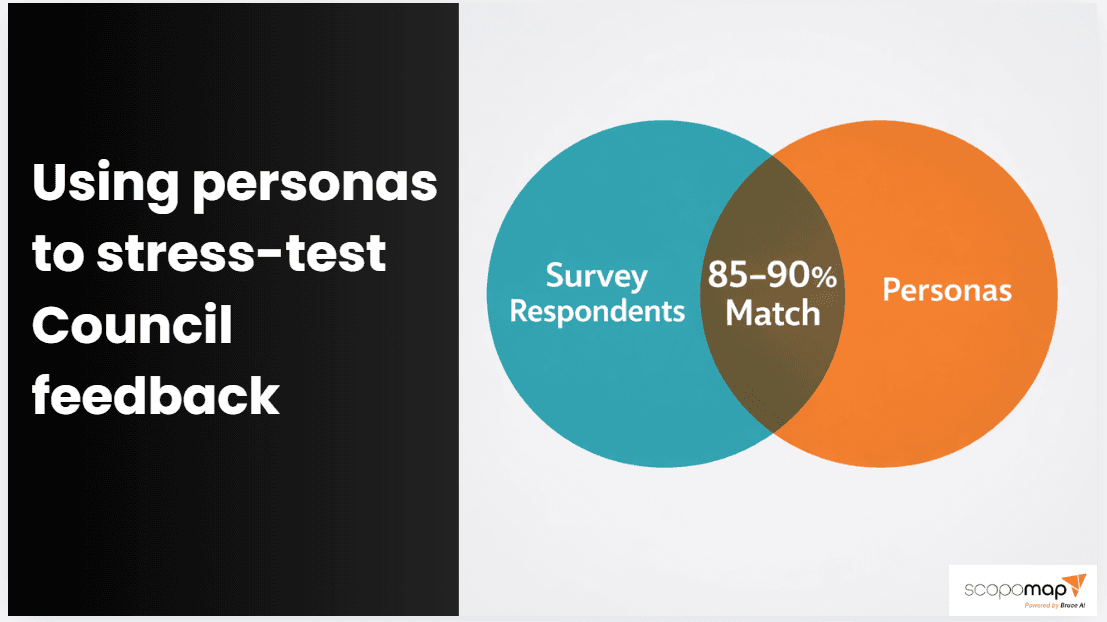
Using Bruce AI, Destination Store compared actual survey responses against the six personas.
The result:
- 85-90% match of survey respondents to the personas' demographics
- 90-95% alignment between survey responses and persona interests
This gave them reassurance that the consultation findings broadly reflected the LGA.
However, the big difference wasn’t in sentiment, but in specificity.
The examples below show how personas are effective in articulating general information, but survey responses provided concrete detail.
Survey Question: What would make you even prouder to live on the Central Coast in the future?
Jess (persona): "A vibrant local culture and creative scene, with more things to do.”
Real survey response: “A natural eco-friendly environment … that combines outdoors and community events into one.”
Barry (persona): "I reckon some of the town centres and main streets could do with a spruce up, make them a bit more pleasant to walk around."
Real persona: “Fix up Gosford Waterfront. It could be an area where people get the train from Sydney or Newcastle. Spend the day there, shopping, eating, looking around and then go home.”
Why you still need to engage
We’ve now seen a similar broad alignment of personas and consultation findings across multiple projects.
This gives us confidence in the utility of personas.
But these projects also highlight the importance of doing real engagement because without real consultation, you miss the concrete detail to turn feedback into insights you can act upon.
What else can personas do?
There's a bunch of uses for personas at different stages of your project, including:
- Predicting objections before you launch
- Testing and refining consultation questions
- Running a virtual focus group
- Tailoring your communication strategy
- Shaping messaging
If you'd like practical guidance on building and using personas, visit our Tutorials and Features page.